EMC
for Systems and Installations: Part 0
The commercial need for EMC in systems and installations plus
Part 1 - Earth? What earth? By Eur Ing Keith Armstrong C.Eng MIEE
MIEEE
|
Introduction
This is the first in a
series of six bi-monthly articles on EMC techniques for system integrators and
installers, which should also be of interest to designers of electronic units
and equipment. The material presented in this series is based largely on the
new book "EMC for Systems and Installations" [1] which I co-wrote
with Tim Williams of Elmac Services. This series will mostly address technical
issues. Apart from Part 0 below, EMC management and legal issues (e.g.
compliance with the EMC Directive) are not covered, although they are in [1].
This series uses a 'cookbook' style and does not go into any great depth in
explaining the reasons behind the techniques described. For more depth, read
the references provided at the end of the articles.
The topics which will be covered in these
six articles are:
- General Introduction to the series - the commercial need for EMC in
systems and installations
- Earth? what earth? (The relevance of what is colloquially called
'earth' or 'ground' to EMC)
- EMC techniques for installations
- EMC techniques for the assembly of control panels and the like
- Filtering and shielding in installations
- Lightning and surge protection
- CE plus CE does NOT equal CE! What to do instead
These EMC techniques apply
to the majority of land-based systems and installations, including:
- commercial and government offices
- call centres
- warehouses and shopping malls
- telephone exchanges
- data processing complexes
- sound, video, film installations such as recording and broadcasting
studios, theatres, and cinemas
- industrial process control and instrumentation
- airports, harbours, railway stations
- heavy engineering industries such as steel mills and shipbuilding
Special systems and
installations such as power generation; hospitals; military sites; AM broadcast
transmitters; vehicles of all sorts (rail, land, marine, aerospace, etc.);
coal, oil, gas, and mineral exploration and extraction; hazardous areas (e.g.
petrochemical plant); etc.; may require some different EMC techniques. Many of
these have their own codes of EMC practice, which should generally be followed.
However, some EMC codes of practice are quite old and may not adequately deal
with modern electronics technologies and the uses to which they are now being
put. Where an existing EMC code is found to contradict the techniques described
in this series, an assessment by a competent EMC expert is recommended to
determine whether the existing code is still correct. Def Stan 59-41 Part 7 [2]
is a fairly recent code of EMC practice for naval systems and installations,
and it employs much the same techniques as are described in this series.
Some of the techniques in this series may
contradict established or traditional practices, but they are all well-proven
and internationally standardised modern best-practices at the time of writing,
and professional engineers have an explicit duty (professional, ethical, and
legal) to always apply the best knowledge and practices in their work.
Remember that safety is always paramount,
and should not be compromised by any techniques intended to help achieve EMC.
This may require the involvement of competent safety experts in making EMC
decisions.
Note that meeting the EMC Directive may not
be sufficient EMC work to achieve functional safety, as required by a large
number of safety regulations (such as the Machinery Directive). Where
malfunction of electronic devices can give rise to functional safety risks
(e.g. in all robotics, and some machines and process control) then EMC must be
addressed as a safety issue, and merely meeting the EMC Directive and relevant
harmonised EMC standards may not be adequate. This topic will not be covered
explicitly in this series of articles, but it is hoped that the Journal will be
able to report before too long on the publication of an IEE Professional
Guidance document on EMC and Functional Safety.
0 The commercial need for EMC in systems
and installations
The use of the EMC
techniques described in this series will:
- save time and money
- reduce the risks of delays in commissioning or putting into service
- reduce the risks (for suppliers) of incurring penalty charges
- improve reliability
- improve accuracy and quality of operation
- reduce the risks of damage to electronics due to earth-faults,
power surges, and thunderstorms
- improve safety (where safety depends upon the correct operation of
electronic devices)
- reduce the overall cost of ownership in recognised financial terms
Using these techniques will
also to help installations to meet the EMC Directive (89/336/EEC, as amended)
with minimum cost, and will help provide a "due diligence" defence
should complaints of interference from the installation be made. Since
factories have been shut down in the past by EMC enforcement agents, using good
EMC practices to help prevent interference incidents is also a best seen as a
commercial risk-avoidance strategy.
This series of technical articles are
intended to reduce the engineering and commercial risks in new system and
installation projects, and to help the new systems and installations provide
high reliability and good quality of operation. Many systems and installation
projects suffer delays and extra cost because of a lack of attention to EMC,
although the problems are not often recognised as such. For example a
manufacturer of chemical process plant once told me that they reckoned on
spending 3 to 5 days on each new plant (cost around £10million each) just to
get the flow-meters to give accurate readings in the presence of the noise from
the inverter motor drives.
Quite apart from the cost of three days of
engineering effort and the extra materials required (screened cables, filters,
etc.), delaying the point at which the plant begins to earn money by as much as
a week probably cost around £300,000 in lost production, and cost an extra
£20,000 in the interest on the £10million loan (assuming a very conservative
10% p.a. rate). £320,000 is a lot to pay for ignoring EMC techniques which are
well known, easily learned, and would have added at most a few hundred pounds
to the material cost.
Some engineers may not appreciate that the
costs of their projects (including their salaries) are effectively bank loans,
on which interest has to be paid. Even though the money may appear to come from
their company's bank account which is in credit, their Financial Director
counts it as money on which he could be earning interest if he hadn't spent it
on engineering, so the effect as far as he (and shareholders) is concerned is
much the same as borrowing it from a bank. If shareholders felt they could earn
more money and/or take less risk by investing their cash in a Building Society,
then they would, and this very attitude is partly to blame for the lack of
investment in engineering in the UK today.
For more examples of the potential of poor
EMC to cause delays, costs, and the invocation of penalty clauses, read
"Banana Skins" item elsewhere in this Journal. This item is part of a
series that has been running since February 1998, and has included some very
scary stories indeed.
1 Earth? What earth?
This section first appeared
as an IEE Colloquium paper [3], in January 2000.
The issues discussed in this section are
very relevant to the EMC practices which will be described in later issues.
1.1 Introduction
The word "earth"
or "ground" means many different things to many electrical engineers.
In an electrical installation these words can be used to mean either the
protective conductor in a mains cord; the common bonding network of the building;
the earth mass electrodes of the lightning protection system, or the conductor
of the mains supply that is connected to an earth mass electrode at the
distribution transformer. This paper will describe the relevance of connections
from an electronic equipment to a protective conductor, common bonding network,
or earth mass, for a number of electromagnetic (EM) phenomena.
A knowledge of where the currents associated
with EM phenomena actually flow is needed for a proper bonding and earthing
design for the control of (EM) phenomena. The outcome of such an analysis shows
that some EM phenomena are strongly affected by such connections, while some
are not. Safety issues are not covered here, except to say that safety should
never be compromised for the sake of EMC. So even when EMC is improved by
removing a protective conductor (for example, to reduce the amount of hum in an
instrumentation or audio system, which is still a common practice) this should
never be done if it might contravene safety requirements.
1.2 Earth, ground, protective conductors,
common bonding networks, and earth mass.
Earth and ground are
synonymous, with the former being used mostly in the UK and Europe and the
latter being used in the USA and Canada. Where the word "earth"
appears in the rest of this paper, it may be substituted with the word
"ground" by those who prefer US terminology.
"Earth" and "earthing"
are much misused and abused terms, bandied about by designers and installers,
and consequently responsible for numerous EMC problems. For example, if an
installation manual says that a cable screen is to be earthed, what does this
actually mean? A 2 metre green/yellow wire from the screen to a chassis stud on
the wall of a cabinet will probably prevent the screen of the cable from
functioning correctly at frequencies above a few hundred Hertz (Hz), so may not
be what was required. So we need to make sure we understand the terms we use,
and use the correct terms when communicating with others. Unfortunately, many
standards use the word "earth" where they should not, and sadly the
author is often guilty of the same errors.
Strictly speaking, earthing should only
refer to a connection to the mass of the Earth (i.e. the planet), particularly
the earth electrodes of a lightning protection system (LPS), or the earth
electrode that connects to one of the mains terminals of an AC mains
distribution transformer (usually the Neutral).
A protective conductor is the
safety-mandated connection to the exposed metalwork of mains-powered equipment
that does not employ double-insulation techniques. The protective conductor is
typically the green or green/yellow wire that is included with the mains cord,
and should connect to a building's common bonding network (CBN). These
conductors may sometimes be called "protective earth" or
"protective earth conductor", "safety earth", or just
"earth", but they are connected to the CBN and so the word
"earth" is inappropriate.
A CBN is the total of all the protective
conductors and the metalwork, water and gas pipes, etc. they are bonded to, in
an installation. Modern wiring regulations require almost everything that is
conductive to be connected to the network of protective conductors, to create a
building's CBN. They also require the CBN to be connected to the mass of the
earth by the earthed neutral of the incoming mains supply, and the earth
electrodes of the LPS (where one is installed), for safety reasons. Because
CBNs are connected to the earth mass they are often referred to as
"earthing networks", "earth bonding networks" or just
"earth", but this is incorrect. The point may seem academic, but will
be seen to be relevant to the interaction of different EM phenomena with CBNs
or the earth mass.
Figure 1 shows the relationship of these
different aspects of "earthing".
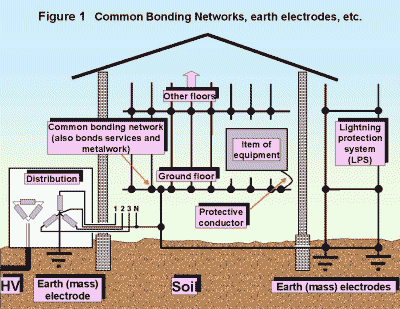 Power distribution systems outside a building generally use one
conductor for both mains neutral and the connection to the earth electrode,
often called the PEN conductor. Some buildings use PEN conductors inside, so
that the mains neutral is also the CBN. These buildings can suffer greatly from
EMC problems, and so PEN conductors inside a building are not recommended
wherever electronic equipment is to be installed, according to a number of
recent standards (i.e. the options of IEC 364 section 546.2.1, or HD 384.5.54
S1:1980, or BS7671:1992 546-02, should not be used).
Power distribution systems outside a building generally use one
conductor for both mains neutral and the connection to the earth electrode,
often called the PEN conductor. Some buildings use PEN conductors inside, so
that the mains neutral is also the CBN. These buildings can suffer greatly from
EMC problems, and so PEN conductors inside a building are not recommended
wherever electronic equipment is to be installed, according to a number of
recent standards (i.e. the options of IEC 364 section 546.2.1, or HD 384.5.54
S1:1980, or BS7671:1992 546-02, should not be used).
1.3 Current return paths
Kirchoff's Law tells us that
the sum of the currents at any electrical node is always zero, so for every send
current (signal or power) there is always an exactly equal and opposite return
current, even where it returns through a number of different paths. The total
path of a current is often called a current loop. Knowing where the return
current flows is a powerful tool when analysing EM phenomena and achieving EMC.
Signal integrity may be seen as a subset of EMC, for example signal integrity
issues inside an equipment could be described as a subset of "internal
EMC" (the propensity of the electronics in an equipment to interfere with
each other). So knowing where return currents actually flow is also very
important for achieving signal integrity.
Unfortunately most electronic designers
start out with a singular disadvantage in this respect - conventional textbooks
and teaching materials on electronics (and most circuit simulators) ignore
return currents completely, or else assume that return paths have zero length
and zero impedance.
1.4 Conductors, bonds, and earth electrodes
have complex impedances
Everything physical has a
complex electrical impedance - i.e. one that varies with frequency. The
inductive impedance of a straight length of wire exceeds its resistive
impedance above a few kHz. As frequencies increase the generally increasing
impedance may show some dips due to stray capacitances. At even higher
frequencies, when the wavelength has become comparable with the length of the
wire, it will behave as a resonant antenna and its impedance will appear either
inductive or capacitive depending on frequency. For example, a straight wire 10
metres long will suffer dramatically from resonant antenna effects at
frequencies above 7.5MHz, whereas a straight wire 1 metre long will resonate at
frequencies above 70MHz.
All wires, cables, and other conductors such
as metalwork suffer in a broadly similar manner. Their actual impedances at
high frequencies depending upon their material, shape (especially
cross-sectional area), length, and proximity to other conductors and
insulators. Generally speaking, rectangular areas of conductor maintain lower
impedances than wires to higher frequencies, and the more square they are the
lower their impedance.
Typical protective conductors are usually
just thin wires, and often travel several metres before they are connected to a
CBN. Protective conductors of this type will have high or indeterminate
impedances at high frequencies, and so are of little use in the control of any
high-frequency EM phenomena.
CBNs are made up of wires and
"natural" metalwork such as re-bars, girders, metal structures,
pipes, ducts, cable trays, conduit, cable armour and screens, etc. The
inductance of a CBN can be reduced (and its usefulness at high frequencies
improved) by connecting all these conductors together as a mesh. A meshed
conductor approximates more closely to a solid area of conductor as mesh size
decreases, so the smaller the size of the mesh, the lower the inductance and
the better the control of higher-frequency EM phenomena.
Earth electrodes also have inductance,
although a well-designed one in a high-conductivity soil may appear
predominantly resistive up to several MHz (if measured at the electrode
itself). Of course, connection to earth electrodes have inductance, and this
can be an important factor in the frequency response of practical connections
to earth mass. Modern earth electrode systems use ring electrodes and the
re-bars in concrete foundations and the like, to achieve a lower inductance
over a site, to help control high-frequency EM phenomena better.
1.5 Differential-mode (DM) and common-mode
(CM)
Where voltages or currents
exist between the two (or more) conductors carrying intentional send and return
current paths, they are called differential-mode (DM). (Another expression
sometimes used to describe differential signals or power is
"symmetric".) Wanted signals and power are almost universally DM.
Every conductor has stray (parasitic)
capacitance and inductance to every other conductor or conductive item. DM
voltages and currents leak out of their intended conductors and into other
conductors or conductive items via these strays. There are large numbers of
different stray capacitances and inductances for each individual signal or
power conductor, so each individual conductor leaks by different amounts. If
the leakages from each DM conductor could be made identical, they would cancel
out and the net effect would be zero. But in reality this ideal can only be
approached, and not achieved. The resulting overall leakage is called
common-mode (CM). Another expressions sometimes used in place of CM is
"asymmetric".
As well as stray leakage from DM signals and
power conductors, there will be different impedances between each individual
conductor and the reference potential (e.g. the chassis) inside equipment, for
both sources and loads. The imbalance in these also influences the conversion
of DM to CM. Figure 2 shows a few impedances which represent the net effects of
all the different impedances contributing to the creation of CM.
Where CM leakage has an effect on other
signal or power conductors, this is usually called crosstalk. Although an
important EMC phenomenon, it is outside the scope of this paper. We are
interested in the CM currents and voltages related to protective conductors,
CBNs, and earth mass.
The propensity for a signal cable to convert
DM to CM, per metre of length, is known as its longitudinal conversion loss
(LCL). Category 3 datacommunication cables have a typical LCL over the
frequency range 1.5 to 30MHz of 50 to 25dB, the LCL decreasing as the frequency
rises. Category 5 cables are made with a tighter control of their twist rate to
give an LCL of around 60 to 35dB over the same frequency range. A figure of
60dB means that 0.1% of the DM signal is converted to CM per metre of cable.
Although Figure 2 shows an untwisted,
unshielded signal cable, the same common-mode leakage mechanisms occur when
signal conductors are twisted or shielded to reduce inductive and capacitive
coupling to the world outside the cable. Twisting and shielding can never be
100% effective, and can be made less effective by poor cable termination
techniques during assembly and installation.
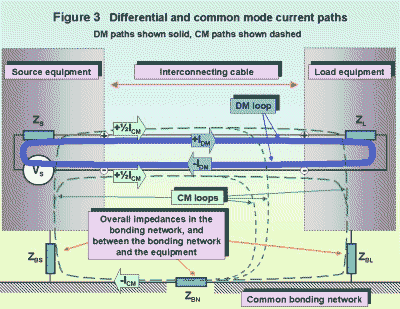
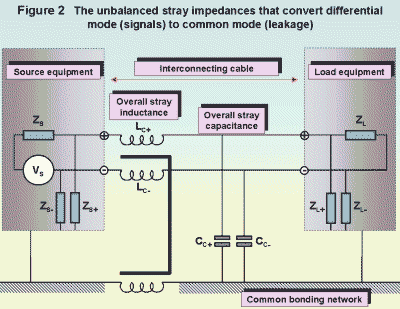 Figure 3 shows that the DM currents for a signal conductor are equal in
magnitude but opposite in polarity (+IDM and -IDM), whereas CM currents experienced
by the output terminals of the source are equal in polarity and each is half of
the total (both +½ICM) For a three-conductor DM signal or power cable the
output CM signals would each be one-third of the total, for a four conductor DM
signal or power one-quarter, etc.
Figure 3 shows that the DM currents for a signal conductor are equal in
magnitude but opposite in polarity (+IDM and -IDM), whereas CM currents experienced
by the output terminals of the source are equal in polarity and each is half of
the total (both +½ICM) For a three-conductor DM signal or power cable the
output CM signals would each be one-third of the total, for a four conductor DM
signal or power one-quarter, etc.
The CM return current (-ICM) in Figure 3
flows back into the source (to satisfy Mr Kirchoff) via any bonds and stray
impedances between the source itself and the CBN, represented by the impedance
ZBS. Even if there were no intentional bonds to the CBN (such as a protective
conductor), ZBS would still exist, because stray capacitances and inductances
would still exist between the CBN and the equipment.
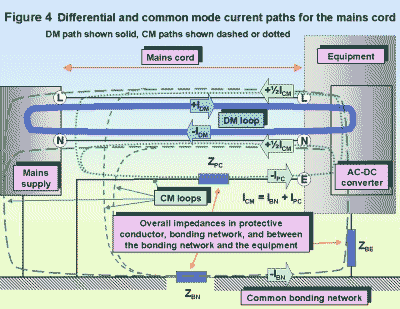
 CM currents in the mains supply to an equipment is the subject of Figure
4. The AC-DC power converter generates DM noise currents due to its
discontinuous and/or non-linear load impedance, with rectifiers and switching
transistors being the main sources. Where the equipment is connected to the CBN
by a protective conductor, there are two sets of leakage impedances and hence
two sets of possible routes for CM return currents: one via the protective
earth conductor (represented by ZPC), the other (actually a multiplicity of
routes) via the CBN (represented by ZBN). Where equipment is double-insulated
there is no ZPC.
CM currents in the mains supply to an equipment is the subject of Figure
4. The AC-DC power converter generates DM noise currents due to its
discontinuous and/or non-linear load impedance, with rectifiers and switching
transistors being the main sources. Where the equipment is connected to the CBN
by a protective conductor, there are two sets of leakage impedances and hence
two sets of possible routes for CM return currents: one via the protective
earth conductor (represented by ZPC), the other (actually a multiplicity of
routes) via the CBN (represented by ZBN). Where equipment is double-insulated
there is no ZPC.
 The above figures only show CM currents and impedances, but CM voltages
exist as the CM currents flow through the various impedances in their current
paths. Reciprocity in DM to CM conversion.
The above figures only show CM currents and impedances, but CM voltages
exist as the CM currents flow through the various impedances in their current
paths. Reciprocity in DM to CM conversion.
The conversion of DM into CM, has been
described above in terms of stray or parasitic impedances, and this process is
very important to the creation of EM emissions, as will be described below. But
this conversion process also works in reverse - externally imposed CM currents
and voltages are converted into DM "noise" in signal and power
conductors. This reciprocity is very important for immunity to EM phenomena, as
will also be described below.
There are two ways of reducing CM (not
including modifying the equipment's circuit design):
- Increasing the CM impedances to reduce CM currents
- Reducing the areas over which the CM voltages apply and in which
the CM currents flow.
Because of reciprocity,
these work equally well for improving both emissions and immunity.
1.5.1 Non-reciprocal CM issues
Here are some CM issues
which are not reciprocal, and so will affect either emissions or immunity.
- Sources of DM never generate exactly correlated currents, voltages,
or source impedances for each of their conductors at every instant, and
these imbalances directly create a CM component and so encourage CM
leakage. This is a problem for EM emissions, but does not have a
reciprocal effect on immunity.
- Self-generated noise within an equipment is an increasing problem as
analogue (continuous) circuit techniques are increasingly replaced with
digital and switch-mode (discontinuous) circuit techniques. The noise
currents created by the circuits' internal operations flow in internal
impedances and create internal CM noise voltages. These noise voltages
appear on all mains and signal conductors, despite being unrelated to
their intentional voltages, and help create CM currents in the world
outside the equipment. This is a problem for EM emissions, but does not
have a reciprocal effect on immunity.
- External CM noise gets converted to DM noise by imperfections in
the CM rejection of electronic circuitry. Even if signal cables had
infinite LCLs, CM voltages presented to electronics can still lead to EMC
problems. This is an EM immunity problem and does not have a reciprocal
emissions problem.
- Demodulation of RF is caused by the inherent non-linearity of
semiconductors. It is not often appreciated by electronic designers that
it acts at frequencies well beyond the intended signals. So it is not
unusual to find a thermocouple amplifier with a 1 second response time
suffering from huge measurement errors when CM voltages at 100MHz or above
are applied to its cables. This EM immunity problem does not have a
reciprocal emissions problem.
1.6 Emissions from equipment
Wherever there is a voltage
there is an electric field, and stray capacitance is just another way of
describing stray electric fields. Whenever we have a current we have a magnetic
field, and stray inductance is just another way of describing stray magnetic
fields. So whenever we use the word "impedance" it is important to
realise that this always means that electric and magnetic fields are present.
EMC is all about controlling electric and magnetic fields, so it may also be
viewed as being all about controlling impedances.
Because CM voltages and currents act over
very much larger distances and loop areas than DM, a given amount of CM voltage
or current represents very much higher emissions of both electric and magnetic
fields than the same amount of DM. So even a very small amount of CM can cause
big problems for emissions.
The brief analyses below generally assume
that the equipment concerned is no larger than a typical floor-standing
industrial cabinet, its signal cables are no longer than 30 metres driving
high-impedance loads, and both it and its cables are entirely contained within
a building.
1.6.1 Emissions below 1MHz
At frequencies below say,
1MHz, most emissions are caused by DM currents and voltages. This is because
the size of the equipment and length of the cables is usually too small, and
their associated stray impedances too high, to give CM problems. It is usually
the mains cable that creates the greatest problems for emissions below 1MHz,
since AC-DC power converters tend to create most of their electrical noise as
DM below 1MHz. Mains cables can be very long, but the close proximity and slow
twist of their send and return conductors helps ensure that radiated emissions
are low, so the problem is usually one of conducted emissions.
Because DM currents and voltages are
confined to their intended conductors, protective conductors, CBNs, and earth
mass all have insignificant effects (the currents of interest do not have a
path that includes them).
The frequency of 1MHz depends strongly on
size of equipment, cable lengths, and load impedances. For example, where a
frequency converter drives an induction motor, the high capacitances between
the motor's windings and its metalwork can cause high levels of CM currents at
frequencies much lower than 1MHz.
1.6.2 Emissions between 1MHz and 200MHz
Above 1MHz stray impedances
become increasingly significant and CM emissions generally rise to the point
where they dominate DM emissions. CM impedances may be increased by making the
equipment double-insulated (removing its protective conductor), removing any
other bonds to the CBN, increasing the distance of the equipment from the CBN,
fitting CM chokes to cables, using cables with better LCL (such as twisted
and/or screened types), and using galvanic isolation techniques (especially
fibre-optic, infra-red, or wireless communications).
CM areas may be decreased by reducing the
impedance of bonds to the CBN (shorter, with increased cross-sectional area),
running cables close to the CBN (and even exposing cable screens every so often
and bonding them to the CBN), reducing the impedance of the CBN by decreasing
its mesh size, increasing the cross-sectional area of CBN conductors, and
fitting capacitors from power and signal conductors to the CBN. Usually, the
above techniques are applied together, e.g. increasing CM impedance by using
fibre-optics in place of copper cables and adding CM chokes to the remaining
copper cables, whilst reducing the area over which the remaining CM acts by
fitting "Y" capacitors between mains terminals and the CBN, reducing
the impedance of bonds between equipment and the CBN, and running cables close
to the CBN.
So in this instance we can see that the
bonds between equipment and CBN (including protective conductors) are important
for controlling emissions, but that sometimes it is better to remove the bonds
or increase their impedance, and sometimes better to add bonds or reduce their
impedance to the CBN. Connection to earth mass has an insignificant effect,
since the current paths concerned do not flow in it.
1.6.3 Emissions above 200MHz
DM radiated emissions are
proportional to their frequency squared, whereas CM radiation is proportional
to frequency. So as frequencies increase, say (very roughly) above 200MHz, DM
radiated emissions may exceed CM emissions. Reducing DM radiation at these
frequencies involves reducing the size of the loop formed by the send and
return conductors, and/or shielding. This has nothing to do with protective
conductors or CBNs. Reducing CM emissions at these frequencies is the same as
it is between 1MHz and 200MHz - sometimes it is better to remove the protective
conductor or other bonds to the CBN, or increase their impedance, and sometimes
it is better to reduce the impedance of the bonds to the CBN. But for both CM
and DM emissions, connection to earth mass has an insignificant effect (the
current paths concerned do not flow in it).
1.7 Immunity to continuous radio frequency
(RF)
Below 80 MHz, EM immunity
test standards assume most of an equipment's exposure to RF is via cables, so
conducted methods are used. The standards also assume that above 80MHz coupling
of radiated fields directly into the equipment may be significant, so radiated
methods are used instead. Both test methods apply their test stimuli as CM, so
what matters is the degree to which external CM stimuli are converted into DM
noise. As described above, there are a number of ways in which this might
happen. The imbalanced impedances that cause DM to CM conversion (and CM
emissions) works in reverse to convert external CM into DM (creating DM noise).
There are also non-reciprocal CM to DM mechanisms which worsen immunity but
don't have a corresponding effect on emissions.
The paths taken by all the CM and DM
currents associated with an equipment and its cables is unchanged, so the
"earth related" techniques used to improve immunity to continuous RF
are the same as for emissions. The conclusions about the relevance of
protective conductors, CBNs, and earth mass to improving immunity are the same,
for a given frequency, as they are for emissions (see above).
1.8 Immunity to transient EM phenomena
EMC test standards include a
number of different types of transient immunity test, e.g. electro-static
discharge; fast transient burst; unidirectional surge (combination wave); ring
wave; and damped oscillatory wave. All of these are applied as conducted high
voltages, and they are applied as DM stimuli (often called symmetric,
line-to-line, or "line-to-ground"), and sometimes also as CM stimuli
(often called asymmetric or "all-lines-to-ground"). To analyse the
benefits or otherwise of connections to the various conductors that may be
colloquially termed "earth" we need to consider the current paths
associated with these stimuli.
Line-to-line stimuli only involve the signal
or power conductors, so "earthing" is usually of no effect, but
"line-to-ground" stimuli include the protective conductor and any
impedance to the CBN in their current paths. The immunity of equipment to
"line-to-ground" transients may be improved either by increasing or
reducing the impedances between an equipment and the CBN, and increasing or
reducing the impedance of the CBN itself may also be effective. (Just as for
improving emissions above 1MHz, described above.) However, the methods used
must not compromise safety.
Surge protection devices (SPDs) are
non-linear resistors that ideally have no effect on a circuit during normal
operation, but when exposed to voltages beyond the normal range reduce their
resistance dramatically to divert the transient and protect the circuit from
damage. SPDs must be fitted either line-to-line or "line-to-ground"
to protect their circuit from those same modes of transients. Too much
inductance associated with SPDs reduces their effectiveness in clamping
transient voltages. The successful use of SPDs connected
"line-to-ground" may need reduced inductances in the protective
conductor, and in any other bonds to the CBN.
As for all the other EM phenomena above,
immunity to transients may be improved by techniques involving protective
conductors and other bonds to the CBN, but sometimes it is better to remove the
bonds to the CBN or increase their impedance, and sometimes it is better to
improve the bonds to the CBN by reducing their impedances. Connection to earth
mass is irrelevant, since the current paths concerned do not flow in it.
1.9 When cables or equipment are outside a
building
The above has only
considered equipment and cables wholly contained within a building. When cables
travel outside a building, or when an equipment is mounted outside building,
they will create CM currents in the earth mass due to stray capacitances and
inductances, just as they do in the CBN when inside a building. Since some CM
current return paths will be via the earth mass the impedances between the
source equipment and the earth mass will be important for reducing emissions.
As discussed above, sometimes emissions and/or
immunity may be improved by increasing the impedances to the earth mass (CM
chokes, fibre-optics, cables with better LCL, etc.) to reduce CM currents, and
sometimes they may be improved by reducing impedances to earth mass (lower
impedance connections to earth electrodes, electrodes with lower inductance,
running cables closer to earth mass and preferably underground, etc.) to reduce
the area influenced by CM voltages and currents. Also as above, practical
solutions often involve applying both types of technique. However, lightning
protection may be a dominant issue and the mix of methods used to improve
emissions or immunity might differ from those used inside a building.
1.10 Conclusions
"Earth" is a word
that should be used with precision to avoid confusion, but usually is not. In
installations, the word "earth" is frequently used to refer to
protective conductors, the building's common bonding network, or a connection
to earth mass. Normal signals and power are differential-mode, but an
inevitable lack of physical symmetry results in a proportion of the
differential signals being converted to common-mode "leakage", and
the resulting leaked currents and voltages cover a much greater area than
differential signals or power they originated from, and so tend to create many
EMC problems.
To analyse whether a connection to an
"earth" is likely to improve an EMC problem or not involves an
analysis of the current paths involved, for both differential and common-mode
currents. The relationship between EMC and protective conductors, common
bonding networks, and earth mass depends on the electromagnetic phenomena
concerned, but many EM phenomena may be controlled either by reducing the
impedances to the common bonding network, or increasing them, or a mixture of
both. Impedances to the earth mass are only found to be important where cables
or equipment are installed outside of a building.
References
- [1] "EMC for Systems and Installations", Tim Williams and
Keith Armstrong, Newnes, 2000, ISBN 0 7506 4167 3.
- [2] Def Stan 59-41 Part 7, Nov 1995, "Electromagnetic
Compatibility - Code of Practice for HM ships - Installation
Guidelines" (all UK Defence Standards are available as free downloads
from http://www.dstan.mod.uk)
- [3] IEE Colloquium Digest Ref. No. 00/016 "Shielding and
Grounding" Savoy Place, Thursday 27th January 2000. Available from:
IEE Publication Sales Department, phone: 01438 767 328, fax: 01438 742
792, Email: sales@iee.org.uk, cost
£20.00 (for postal delivery in the UK).
