Product Safety - connection to external power sources - the implications of hazardous voltages, energy and power
By Gregg Kervill
|
Introduction
This is the fourth article in our series explaining some detailed aspects of product safety. Unlike previous short papers we are not attempting to fit 'the solution' into a mere single 2,000 words but will, over the coming months, provide the reader with a basic introduction, understanding and working guide to the Low Voltage Directive.
Please note that the information contained in this series is intended to provide an awareness of product safety and is not intended as an alternative to reading and understanding the relevant safety standard.
Readers with specific requests for future subjects should address them to "The Editor quoting GKCL04".
In this article we shall provide a general explanation of how life can suddenly become many times more difficult when we connect mains power - or even battery eliminators, in-cord or socket mounted power supplies.
In an attempt to simplify the issues involved we will break down some of the safety issues and analyse how they are affected by the three principle methods of bringing mains power into the equipment, we shall also consider the application of external battery eliminators and other sources of power.
Definitions
- Mains Voltage - Within the European Union this is a nominal 230Vac, 50Hz.
- Input Current - the maximum current that the equipment is likely to take.
- Input Power - the maximum power that the equipment is likely to take - this unit may cause confusion when we look at the sum "Voltage times Current" which seldom equals the Watts consumed by the equipment.
- Rating Label - there is a mandatory requirement to supply rating information and manufacturers details.
- ELV - Extra Low Voltage - typically less than 60Vdc with only one level of protection from hazardous voltage - not 'safe' for Operators to touch.
- SELV - Safety Extra Low Voltage - typically less than 60Vdc with two levels of protection from hazardous voltage - if the current and energy levels are high then SELV can present an energy hazard.
- SELVEL - Safety Extra Low Voltage Energy Limited - typically SELV and may be as little as 15W: the standards generally accept that an operator may contact this voltage without risk.
- Hazardous Voltage - anything that is not SELV or connected to Safety Earth Ground
- Hazardous Energy - typically anything greater than 8 Amps, 20 Joules, or 240 VA; please note that some requirements have significantly lower limits. Try charging a 1µF to peak mains - about 50mJ - and discharging it. Yes it hurts and we don't want to do it again do we? Then why should we consider subjecting our customer to any greater level of discomfort?
- Earth Leakage Current - the current that flows through the Safety Earth Ground conductor under normal operating conditions. This is generally caused by reactive elements within EMC filters and from stray resistive effects - it is the fault current that may be 'expected' to pass through the operator if the safety earth ground on the equipment fails - for normal "domestic" or type "A" connectors, the maximum limit is generally 3.5mA.
General Considerations
Whereas it may be considered reasonable to warn "Service" personnel of potential hazards and to install safety devices such as disconnect devices and short current protection: it is not reasonable to expect "Service" personnel to deduce any safety limitation of the equipment that must be addressed. Nor should we consider it reasonable for "Operator" safety to depend solely upon understanding and compliance with warnings.
Hence we have a duty of care to give sufficient information to ensure that the installation and use are safe. We also have a duty of care to ensure that the "Operator" of the equipment is protected under conditions of "reasonable use", "foreseeable misuse" and single-fault conditions.
Among the many conditions that we must consider is the Earth Leakage Current. This must be less than 3.5˙mA for all equipment that has a 'type A' (domestic) connector: Permanently Connected equipment or equipment connected via 'type B' (industrial) connectors may exceed this limit under certain circumstances. This detail is particularly important for system integrators where the combined Earth Leakage Current of individual items may significantly exceed the 3.5 mA limit.
If the Earth Leakage current exceeds 3.5mA then the use of 'domestic - type 'A' plugs is prohibited and either an industrial 'type B' plug must be fitted or the equipment must be Permanently Connected - Warnings must be added and the wiring must comply with minimum size requirements.
In most applications it will be essential to provide the mains plug as part of the equipment - this obviously must be suitable for the country of intended use. Ensure that abnormal testing takes into account the overload protection available. Many Continental supplies are protected by 16 Amp circuit breakers. Is the power cord capable of carrying the fault current?
 There are occasions where US NEMA type plugs being used within 'rack' mounted equipment. There are obvious issues about the voltage rating but more important - there is a risk that the operator may contact hazardous voltages on this type of plugs. If we compare the pins in the illustration to the insulated pins of the UK plug we can see how accidental "Operator" finger contact with this type of connector can occur.
Permanently Connected
This equipment is usually fixed permanently within the building (e.g. wall mounted) - or is sufficiently bulky that it cannot be readily moved.
It is accompanied by installation instructions and is not intended to be installed by the "User" but by a trained and competent "Service" engineer.
Within Europe it is acceptable for "Service" safety instructions and warning to be given in the English language: do be careful to use words that are clear, precise and unambiguous. (The only exception to this is Canada where "Service" safety information must be in English and also in French.) If the equipment requires a Safety Earth Ground then that should be clearly stated within the instructions and the labelling on the equipment.
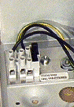 Wiring terminals must be 'suitable' for the application; unlike those shown in the illustration - they must be clearly marked. There must be access to make the connection and to use a tool; there must be access to check that the connection has been made correctly (e.g. connection to the correct terminal and that strands of copper are not bridging the terminals).
The equipment should contain a suitable disconnect device, overload and short-circuit protection. In many instances it will not be possible to estimate what the maximum short-circuit current may be - much less provide adequate protection for it. Therefore we must clearly state the need for any additional, external, protective or disconnect devices that must be installed. We must also provide sufficient information to allow "Service" personnel to fit a suitable device in the correct location. Clearly it is unreasonable to expect the installation engineer to deduce this information - it is we the designers who are aware of the equipment's limitations and it is therefore our duty and responsibility to give sufficient information to ensure that the installation and use are safe.
Fixed Power Cord
 Providing a fixed power cord will avoid some of the consideration that we must make for Permanently Connected Equipment - it does, also, bring into play a number of other factors that we must consider carefully.
We need not provide marking for terminals or such detailed connection instructions. However we must consider strain relief of the power cord. This is often overlooked and only a careful selection of a suitable grommet and good manufacturing controls will ensure compliance.
 We must also consider what happens when the power cord is replaced. Obviously we do not expect the "Operator" to take the unit apart: nor do we expect that equipment to be returned to us to replace a damaged power cord. However, it is possible for a competent "Service" engineer to replace it. Are there special tools, crimps, or other parts required to ensure that safety is preserved? If replacement of the power cord is "Reasonably Foreseeable" then, under the LVD, we may have a duty of care to provide "Service" instructions or warnings. In this illustration it is obvious that special crimps and a crimp tool will be necessary to replace the power cord. Would a PCB mounted terminal strip have be a better alternative?
Detachable Power Cord
 This method of connections provides a great deal of flexibility to the producer - and still more considerations of which we must be aware before we can commence the detailed design of the product.
The use of a detachable cord allows individual power cords to be supplied for each country of use, with the minimum of documentation and instructions for the user. This is a great advantage as it can avoid the use of 'country kits' that were the bane of engineers lives in many international companies.
However we must consider where the equipment may be used more carefully. The LVD uses the phrase "reasonable use and foreseeable misuse" as a warning for us to consider how safety could be compromised.
Will the equipment be sold in other countries? Probably yes, if not by your company then by an importer or system integrator.
Will it be supplied with other power cords? If it is supplied elsewhere then it certainly will be.
What protection will be in place? If it requires a 3Amp fuse or circuit-breaker to protect the equipment or its input then this must be provided in the equipment or specified in the instructions and to all potential re-sellers.
Does protection rely on a fused mains plugs or the polarisation of the connector? REMEMBER: Some Continental plugs are not polarised and Live and Neutral may be transposed . If the short-circuit protection supplied by the mains (typically a 16˙Amp circuit breaker) then it may be necessary to fit inlet fuses in the Live and Neutral.
ELV
When powering equipment from an Extra Low Voltage source we must prevent the 'Operator' contacting conductive parts of the power source. Generally - external ELV conductors should be covered by Basic plus Reinforced insulation rated for the maximum mains voltage of the equipment. (e.g. Reinforced, or Basic plus Supplementary, insulation rated at 300V for equipment designed to operate at 230Volts).
SELV
If we power equipment from a remote Safety Extra Low Voltage source, such as batteries or power outlet from another item of equipment, we can assume that the Voltage levels are safe to touch: we must, however, make no such assumption about the Current or the Energy levels. Depending upon the SELV source it may be possible to draw many tens (or even thousands) of amps, under fault conditions. The hazards can range from fire to local burns from metal objects such as jewellery or watch straps.
It is therefore to dispel the mistaken belief that SELV sources are 'easy' or that "if our equipment is powered by SELV we do not need to do anything else because it will comply with the LVD". Such beliefs are wrong.
Similarly there is another line or argument that if the equipment is powered by SELV it is outside the scope of the LVD and therefore exempt from Product Safety requirements: this is also wrong. Ask the question "Is it reasonable to place an unsafe product on the market?" if it is not then "How do I know that my product is safe unless I review and test it for Product Safety?"
SELVEL
Some SELV sources are limited in the energy that they can provide - this may be by the inherent design of the transformer or by the use of fuses. These outputs are know as Safety Extra Low Voltage Energy Limited and the levels to which they are limited will define if they are safe for "Service Personnel" or "Operators" to contact.
Hazardous levels are, generally, defined as 60 Volts, 8 Amps, 20 Joules, and 240 VA; however, this limit varies between countries - 50 VA and 15 VA are also quoted as the maximum energy that the 'Operator' may contact. Obviously it is wise to check local regulations before starting the design.
The use of SELVEL is also important in reducing the degree, complexity, and cost of carrying out the prescribed "Abnormal Tests".
Summary
Equipment that relies upon a 3 Amp fused and polarised mains plug may become a fire hazard if connected via a non-polarised connector protected by a 16 Amp circuit breaker - if in doubt TEST do not guess or assume that the user, or installation engineer will know.
Successful Abnormal and Fault testing can save many a sleepless night!
Remember also that instructions and warnings form part of the product.
In the next article we consider the Product Safety implications of internal power supplies and energy sources.
Please note copyright reserved by GK Consultants Ltd., tel: 01703 767739, fax: 01703 767789, email: sales@gkcl.com, URL: http://www.gkcl.com
Archive Index
EMC Journal Home

© Nutwood UK Ltd 2001
|
Eddystone Court - De Lank Lane
St Breward - BODMIN - PL30 4NQ
Tel: +44 (0)1208 851530 - Fax: +44 (0)1208 850871
nutwooduk@nutwood.eu.com
|
|