 |
Protecting Components Against Damage from Electrostatic DischargeBrian Jones explains the principles |
|
Protecting Components Against Damage from Electrostatic DischargeBrian Jones explains the principles |
Damage can occur when a voltage appears across two or more pins of a device (and therefore the internal circuitry) which is greater than the dielectric breakdown strength. This is predominant failure mechanism in MOS devices. The thinner the oxide, the greater the susceptibility to ESD. The failure commonly manifests itself as a resistive short to Vdd or Vss. On bipolar devices, damage can occur where metallisation runs over active semiconductor regions separated by a thin oxide layer, and this results in high leakage paths.
Another mode of failure is caused by a junction reaching the melting point of silicon (1415°C). The energy of the ESD pulse can produce localised heating, and hence a failure by this mechanism, even though the voltage is below that necessary to cause dielectric breakdown. The breakdown of an emitter-base junction of an NPN bipolar transistor, resulting in low current gain, is a typical example of such failures.
Devices may also be degraded by ESD without an immediate functional failure. Such devices with latent damage are often called "walking wounded", and will exhibit a greater susceptibility to future damage from ESD or conducted transients, once in service.
It is important to note that damage to the device can occur at discharge voltages well below those which would be perceptible. The threshold of feeling varies between individuals from three to five kilovolts, yet component damage may occur at potentials of only a few hundred volts.
The effects of ESD damage were first noticed in the 1970s as new technologies resulted in components with a much greater susceptibility to damage. Losses caused by ESD were estimated to amount to many millions of dollars annually. Consequently, many large component and equipment manufacturers introduced special techniques to reduce charge build-up in the production facilities, and were rewarded with increased yields, and improvements in reliability. Users carrying out their own maintenance also learned the importance of preventing damage from ESD.
The first step to controlling the build-up of electrostatic charge is to understand the mechanisms which generate static electricity.
Voltages are created by the bringing together and separation of dissimilar materials. It is not necessary for them to be rubbed together, although this can increase the efficiency of the charging. This effect is known as tribo-charging, and the voltage created depends on the nature of the materials involved. The triboelectric series lists materials in a hierarchical order. If two materials come into contact the higher will give up electrons to the lower, resulting in positive and negative charging, respectively. The further apart in the list the materials are, the greater the charging that will result. A triboelectric series of common materials is shown in Table 1.
| Table 1 - Triboelectric series |
|
 |
|---|
The solution to the problem involves the prevention of the buildup of charge in the vicinity of ESDSs where they are exposed during manufacturing and maintenance operations, and the packaging of these devices in a way which prevents discharges to them during transport and storage.
A number of means may be employed. The most appropriate will be the techniques which maintain the necessary conditions at minimum cost, and these may vary from product to product, and location to location.
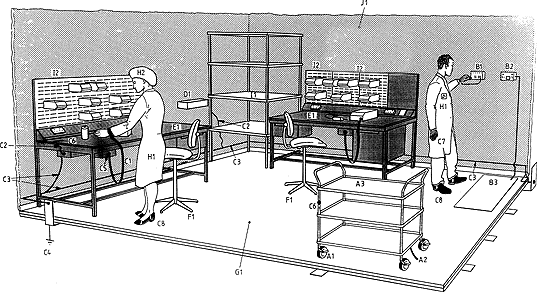
The EPA, sometimes referred to as a safe handling area, is at the heart of any ESD control measures. In such an area, ESDSs or circuit boards, or assemblies containing them, may be worked on without risk, since the levels of charge are controlled to prevent damaging potentials appearing. Such areas may typically encompass a bench or collection of benches, workstations, process equipment such as an automatic component insertion machine, or an entire production area.
The boundary of the EPA must be clearly identified, preferably with a physical barrier to prevent entry by unauthorised personnel. Materials used within the area should be chosen to minimise the build-up of charge, and to cause any charges to leak away to earth in a controlled manner.
| Table 2 - The ESD Protected Area |
|
|
|---|
Working surfaces [E1] should be static dissipative, and connected to ground [C4] via an ESD earth facility [C3]. Operators at workstations will be connected to the ground potential via a cord to a conductive wristband [C1], whereas for more mobile personnel, grounding via footwear heel and toe straps [C8] to a static-dissipative floor [G1] is more appropriate. Cords from wristbands are terminated on earth bonding points [C5].
The over-garments worn by personnel [H1, H2] should be static-dissipative and cover the individual's own clothes where they may be in the vicinity of ESDSs. Any gloves worn [C7] should be of volume conductive material.
Seating [F1] should not be considered as the primary means of grounding an operator, but should be covered with antistatic material, with a conducting path from the seat, back, and arms to the floor.
Components should be stored on shelving with grounding surfaces [I1], or grounded racking [I2]. These, and the workbenches, are connected to the ESD earth via ground cords [C2].
Where components or sub-assemblies are transported on trolleys, these should have surfaces [A3] of similar conductivity to the work surfaces, and a conductive frame. If the wheels [A1] are volume conductive, and in electrical contact with the frame of the trolley, the use of a grounding wiper [A2] will be unnecessary. If the floor of the EPA is not grounding, then the trolley should be grounded from its grounding point [C6] to an earth bonding point [C5] when stationary for loading or unloading.
The efficacy of the measures should be evaluated using an electrostatic voltmeter to measure the potentials and fields remaining, during normal work by personnel. The most accurate of these use a "field mill" principle where a rotating vane "chops" the impinging field to prevent drift. Additional measures include control of humidity to not less than 20%, or the use of ionisers [D1]. The latter tend to have only a local effect.
Signs [J1] should be used within, and at the entrance/exit to, the EPA to remind personnel of their responsibilities.
Wristbands and cords should be tested regularly using an electronic continuity tester [B1]. Conductive heel and toe straps should be similarly tested [B2, B3].
EPAs will often contain mains powered tools and equipment. The direct connection of individuals to ground would be hazardous in such circumstances. For this reason, a resistance of not less than 1 M is included in the wristband cord, and the heel and toe strap connection. Some wristband cords have such a resistor at each end, so that even if the cord snags on a live terminal of a mains powered product undergoing maintenance, a hazard is not created.
The testers for wristband cords check that the resistance is The testers for wristband cords check that the resistance is not too high (so that equipotential bonding is not achieved) nor too low (creating a safety hazard).
The wristband cords are provided with quick-release connections which are not compatible with other electrical connectors. This ensures that they cannot be mated to any other electrical connector, and will snap apart in an emergency.
Good EPA working practices
Charges and potentials will not be maintained within acceptable levels within the EPA if sound working practices are not followed. Some examples of possible pitfalls include: paperwork contained within plastic covers which are not antistatic, plastic drinks containers or cups brought into the EPA, and the use of cleaning materials which destroy the static properties of work surfaces or floors.
Personnel should have adequate training which includes the reasons for taking precautions, as well as the procedures to be followed. Knowledge of the value of the components which could be damaged will also help.
Someone should be nominated as responsible for the maintenance of the EPA, and ensuring correct procedures are audited. These audits should also be checked as part of the Quality Management System audit.
Transportation and storage
For transportation of individual leaded devices, conducting foam is often employed. This prevents a potential difference of more than a few volts appearing across the pins. Dissipative tubes are used for bulk supply of dual-in-line packages.
Populated boards should be transported in static-shielding bags or conductive tote boxes when outside the EPA. Some bags are made from volume conductive material which ensures under steady state conditions that all parts are at the same potential, and dissipate any charge brought to the bag evenly. They are unsuitable for boards containing batteries, and a multi-layer bag with a static dissipative inner and a conductive outer must be used. These bags are more expensive, but can provide superior protection for both powered and unpowered assemblies. Similarly, conductive boxes with guides to hold the boards in place cannot be used with powered boards having bare edge connectors.
Products which are to be serviced in the field should be fitted with electrostatic bonding points so that the service technician can attach his wristband cord before opening the cover. Spare parts should be transported inside static shielding bags or containers unless they do not contain ESDSs. Where modules are to be worked on in an exposed state, static-dissipative matting should be bonded to the product's electrostatic bonding point, to act as a work surface.
The first attempt at documenting best practice in the UK resulted in the publication of BS 5783 in 1987. This was a code of practice rather than a standard against which audits (in particular Quality Management System audits) could be made. The next stage of development was to convert this to a specification within the European framework as CECC 000151, entitled Basic Specification: Protection of Electrostatic Sensitive Devices Part 1: General Requirements. This was published in 1991, and renumbered EN 1000151 in 1992. Further parts followed in 1993 (Part 2: Requirements for low humidity conditions) and 1994 (Part 3: Requirements for clean room areas, and Part 4: Requirements for high voltage environments). These specialised parts are outside the scope of this article.
The standards include not only the requirements for setting up, maintaining and auditing the measures described in this article, but also detailed requirements for the electrostatic protection products themselves, including test methods.
Experience gained in the use of the standards, together with advances in technologies and techniques, and the increase in the use of automatic machinery has led to them being revised. The opportunity has also been taken to rationalise the structure and split the user guidance from the normative text. Work on the revision has moved into the international forum of IEC, and the new standards will be published in the IEC 1340 series, no doubt with a European counterpart. The complete list of parts to be produced is shown in Table 2.
| Table 3 - IEC 1340 Projected structure | |
|---|---|
| IEC 1340-1 | General |
| IEC 1340-1-1 | Guide to the principles of electrostatic phenomena |
| IEC 1340-1-2 | Definitions and terminology |
| IEC 1340-2 | Measurement methods in electrostatics |
| IEC 1340-2-1 | Charge decay |
| IEC 1340-2-2 | Chargeability |
| IEC 1340-2-3 | Resistances and resistivities |
| IEC 1340-3 | Methods for simulating electrostatic effects |
| IEC 1340-3-1 | Human Body Model |
| IEC 1340-3-2 | Machine Model |
| IEC 1340-3-3 | Charged Device Model |
| IEC 1340-3-4 | Field Effect Model |
| IEC 1340-4 | Standard test methods for specific applications |
| IEC 1340-4-1 | Floor covering evaluation |
| IEC 1340-4-2 | Packaging |
| IEC 1340-4-3 | Footwear |
| IEC 1340-5 | Specification for the protection of electronic electrostatic sensitive devices |
| IEC 1340-5-1 | General requirements |
| IEC 1350-5-2 | User guide |
| IEC 1340-6 | Techniques to control electrostatic phenomena & methods to assess their effectiveness |
| IEC 1340-6-1 | Ionizers |
| Of these, none are yet published, but IEC 1430-5-1, and IEC 1430-5-2
have been circulated for public comment. | |
| EN 1000015, and the drafts for public comment of the two IEC drafts,
may be purchased from BSI. | |
 © Nutwood UK Ltd 2001 |
Eddystone Court - De Lank Lane St Breward - BODMIN - PL30 4NQ Tel: +44 (0)1208 851530 - Fax: +44 (0)1208 850871 nutwooduk@nutwood.eu.com |
|
|
|